Offshore Grid
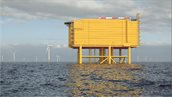
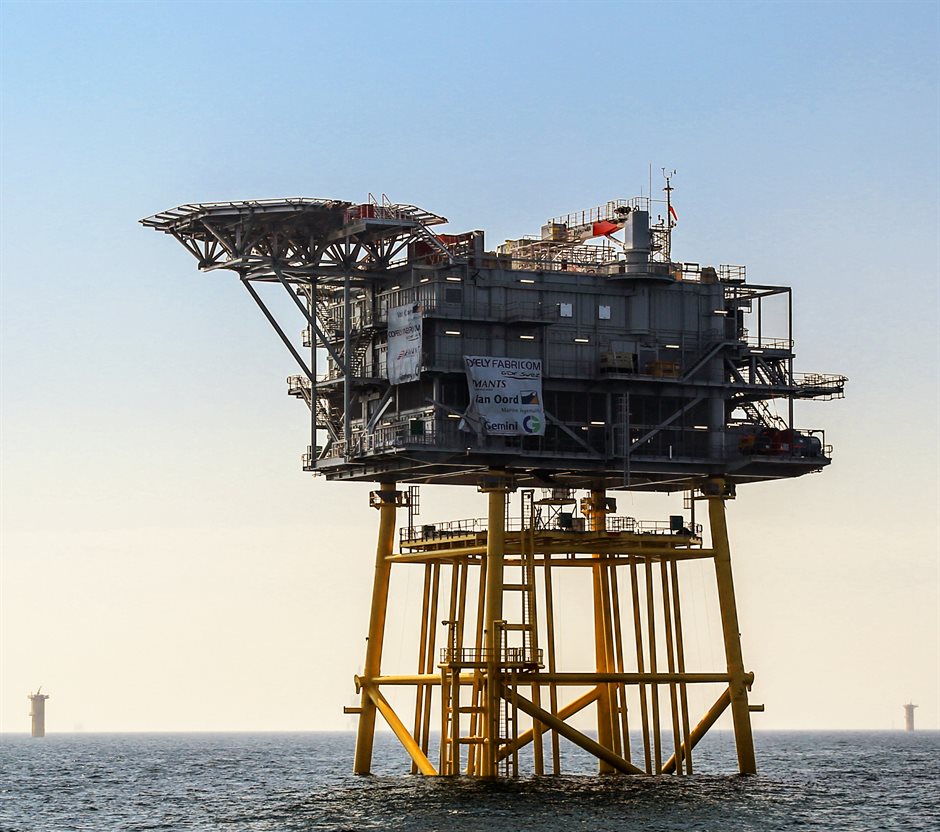
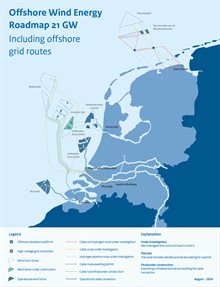
Under the terms of the Electricity Act 1998, TenneT is the designated operator of the offshore grid for the new wind farms. TenneT is responsible for connecting the offshore wind farms to the onshore high-voltage grid and for the distribution of the wind-generated electricity. To this end, since 2019 TenneT has been installing platforms in each of the wind farm zones in the North Sea. So far, two platforms have been completed in the Borssele wind farms, two in the Hollandse Kust (south), and one platform in the Hollandse Kust (north), Hollandse Kust (west alpha) and Hollandse Kust (west beta) wind farms respectively. Hollandse Kust (north) came onstream at the end of 2023, meaning that all wind farms in the Offshore Wind Energy Roadmap 2023 are now supplying electricity. TenneT is now working on the platforms for the wind farms in 21 gigawatt Roadmap (2033). The Nederwiek 1 and 2, as well as the IJmuiden Ver alpha, beta and gamma projects, are currently under construction. The tendering procedure for permits for the Nederwiek 3 project are now at the planning stage, and preparations are underway for the Doordewind wind farm.
For each wind farm, the offshore grid will consist of the following:
- one or two offshore platforms (transformer substations)
- electricity cables from the platforms through the seabed and then underground from the point of landfall to a new transformer substation
- a transformer substation close to an existing high-voltage station
- an (underground) connection to the high-voltage grid
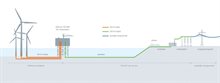
Legend:
- 66 kV kabel 66 kV cable (orange)
- 220 kV kabel 220 kV cable (green)
- landelijk transportnet national electricity distribution network (blue)
Platforms
On each platform for those projects already completed for the Offshore Grid, connections of up to a total of 700 MW can be made. The energy generated by the wind farms is brought together on the platform and then transmitted via two 220 kV alternating current cables on the sea bed to a high-voltage station on the mainland. The energy is then distributed to households in the Netherlands via the national 380 kV high-voltage grid.
For the wind farms currently being constructed or planned, the situation is slightly different. In these cases, the 66 kV alternating current generated by the wind turbines is converted to 525 kV direct current via offshore converter stations with a capacity of 2 gigawatts, and then re-converted to 380 kV alternating current onshore. This is being done because these new wind farms lie much further out from the coast and transmission of electricity by means of direct current results in a smaller loss than the use of alternating current. Systems using direct current are much more expensive than those with alternating current. Despite this however, their higher efficiency makes them more cost-effective over long distances.
Platforms using alternating current and those using direct current have been standardized. This standardization helps reduce the costs of their development, construction and maintenance significantly.
Exploratory studies
At the end of 2019 a start was made with the exploration of cable landing points for offshore wind energy (VAWOZ). This exploratory study was used to investigate how the energy from offshore wind farms yet to be built could, in future, best brought to land. This looked into the form (electrons or hydrogen molecules), the method of transmission (cable, tube or boat), the route and also the issue of where the energy could best be brought to land. VAWOZ lays the foundations for decision-making in relation to the cable landing options for which land use procedures can be started.
VAWOZ relates to two periods. The first period assesses possibilities for bringing extra wind energy to land in 2030. This acceleration is necessary if we are to meet the 2030 climate goals and assumes merely the possibilities for bringing the generated wind energy to land using electrons. In addition, we are doing a similar exploratory study for the period between 2030 and 2040, in which we are looking further at form, transmission and distribution, route and landing point. More information on VAWOZ.